Architecture

How Prompt Tornado is built.

A crawlable overview of the six layers that turn one prompt into a routed, recoverable, recorded workflow: the planner, the task registry, the routing layer, the executor, the run ledger, and the evaluation gate.

The pipeline, layer by layer

A request flows top to bottom. Each layer has one job and hands a well-defined artifact to the next.

01 · Planner
Decompose the prompt

Turns a compound request into a typed, ordered plan of tasks with dependencies. Evaluated at 98% planning accuracy across 200 prompts, and 100% deterministic — identical prompts produce identical plans.

02 · Task registry
Know the task types

A catalog of 181 task types across 17 categories, each with detection signals and a recommended model. The registry is the single source of truth the planner and router agree on.

03 · Routing layer
Pick the model

Maps each task to the best-fit model across seven providers, with ordered fallback. See multi-model routing.

04 · Executor
Run the plan

Executes tasks in dependency order, handles retries and failover, and passes outputs between dependent steps. A dependent step only starts once its input is ready.

05 · Run ledger
Record everything

Every run is an inspectable record — models, providers, latency, tokens, cost, status, and a full execution audit log of events with per-event payloads.

06 · Evaluation gate
Guard quality

The CI quality gate blocks deploys on regressions, so routing and prompts can change without silently degrading. See evaluation.

The run ledger, concretely

Every execution emits a structured audit log. Here is the event sequence from a real 3-step run, each event carrying an inspectable payload.

EventWhat it records
run_startedRun created; input prompt and run ID captured.
plan_createdThe planner's typed, ordered task plan for this run.
step_startedA task begins — its type, chosen model, and provider.
step_completedA task finishes — output, latency, tokens, status, and any fallback.

In the example run, this ledger captured three completed steps in 109.38s for 5,929 tokens at $0.0245. See the full run →
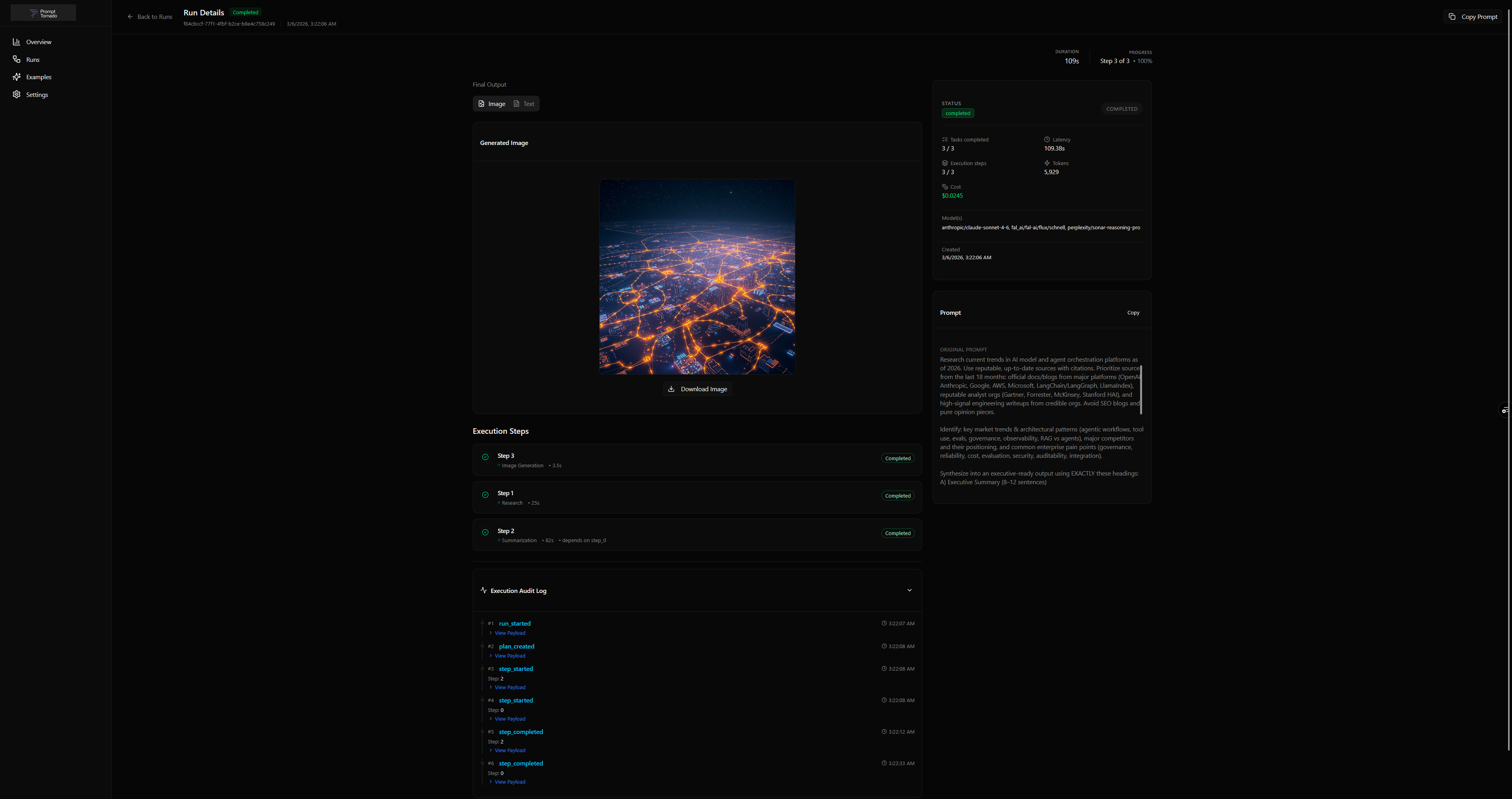
Prompt Tornado run details view showing the execution steps and audit log for a completed workflow.

Design principles

Frequently asked

What makes the planner reliable?
It's deterministic — identical prompts produce identical plans — and evaluated at 98% planning accuracy across 200 compound prompts for valid schema, correct ordering, and no hallucinated tasks.
Where does the routing "source of truth" live?
In the task registry: 181 task types across 17 categories, each with detection signals and a recommended model. The planner and router both read from it.
Is this an agent framework?
No — it's a managed orchestration platform. The layers above are shipped behavior, not building blocks you assemble. See how it compares to LangChain.

See the architecture run a real workflow.

Plan, route, execute, record, and evaluate — in one platform.