Category

AI workflow orchestration, done reliably.

An AI workflow orchestration platform turns a single request into a sequence of tasks, runs each on the right model, and holds the whole thing together with routing, fallback, and evaluation. Here's what that means — and why single-model prompting keeps breaking.

AI workflow orchestration is the practice of coordinating multiple AI tasks — and often multiple models and providers — so that one high-level request is executed as a reliable, repeatable pipeline instead of a single prompt.

A real request usually contains several distinct jobs. "Research this competitor and draft a launch email" is at least three tasks: gather and summarize information, reason about positioning, and write persuasive copy. Different models are better at different ones. Orchestration is the layer that detects those tasks, assigns each to a suitable model, runs them in order, and assembles the result — while handling the failures that happen along the way.

Why single-model prompting breaks down

Sending everything to one model in one prompt works in a demo and then quietly degrades in production.

One model isn't best at everything

A model that writes beautifully may reason poorly about numbers; a strong reasoner may be slow and expensive for simple extraction.

Providers fail

Rate limits, timeouts, and outages happen. A single-provider prompt has no plan B, so the whole workflow fails with it.

Quality rots silently

Prompts and model versions drift. Output gets subtly worse and nobody notices until a user does.

No record

When something goes wrong, "the AI got it wrong" isn't debuggable. You can't see which step failed or why.

How Prompt Tornado orchestrates a request

A request moves through a control plane — a single layer that governs how work flows through AI models.

01
Detect

The request is decomposed into discrete task types, matched against a 181-task intent registry.

02
Route

Each task is sent to the model best suited for it, based on task type and cost/quality tradeoffs.

03
Recover

If a provider errors or times out, the task fails over to an alternative model automatically.

04
Record

Every step becomes an inspectable run: model, provider, latency, tokens, cost, and fallbacks.

The routing decision is driven by a task-intent registry rather than ad-hoc rules scattered through code — which is what keeps it correct as new models ship. More on the multi-model routing and architecture pages.

Example run · 3 tasks · 3 providers

One prompt, orchestrated end to end

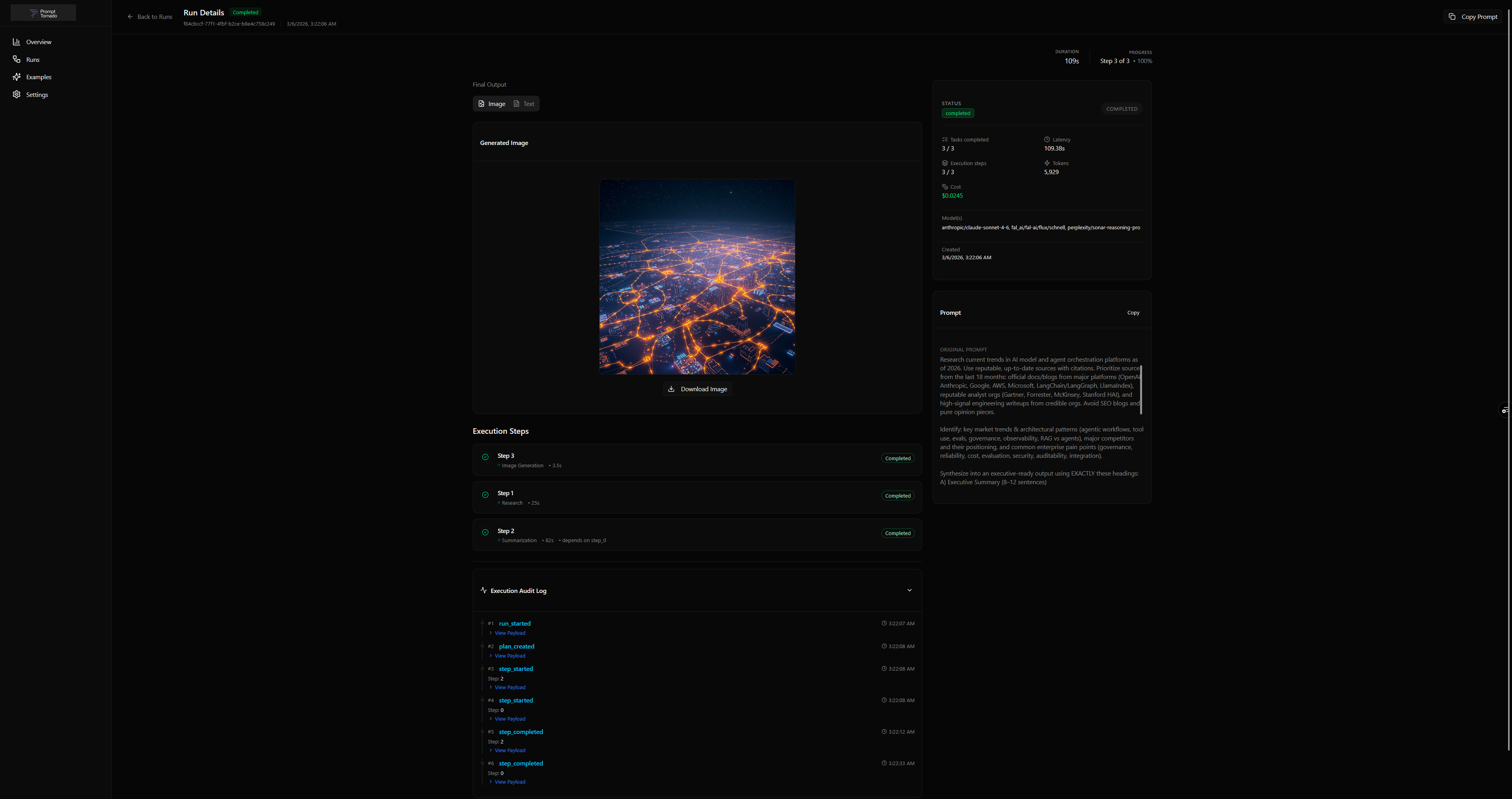
A real run: "Research current trends in AI model and agent orchestration platforms as of 2026." Prompt Tornado planned it into three tasks and routed each to a different provider.

3/3
Tasks completed
research · summarize · image
109s
Total latency
end to end
5,929
Tokens
across all steps
$0.0245
Total cost
per run
StepTaskRouted toTime
1Researchperplexity / sonar-reasoning-pro23s
2Summarization (depends on step 1)anthropic / claude-sonnet-4-682s
3Image Generationfal.ai / flux/schnell3.3s
Prompt Tornado run details: a completed 3-step workflow showing tasks, models, latency, tokens, cost, and an execution audit log.

Each run carries a full execution audit log — run_started, plan_created, step_started, step_completed — with per-event payloads. See how quality is evaluated →

Where teams use it

How it compares to generic automation tools

Tools like Zapier or Make orchestrate apps — they move data between services when a trigger fires. Prompt Tornado orchestrates AI reasoning itself: which model handles which cognitive task, what happens when one fails, and whether the output met the bar. See the full comparisons.

Frequently asked

Is AI workflow orchestration the same as an AI agent framework?
They overlap. Agent frameworks give you building blocks to write orchestration logic yourself. An orchestration platform like Prompt Tornado ships routing, fallback, and evaluation as managed behavior so you don't rebuild it per project.
Do I have to pick one model provider?
No — that's the point. Prompt Tornado routes across multiple providers and falls back between them, so you're not locked to a single vendor's availability or strengths.
How do I know the output is good?
Through evaluation gates and run traces. See AI workflow evaluation for regression checks and fallback monitoring.

Turn one prompt into a reliable workflow.

Route across the best models, fall back automatically, and see every step.