Production-ready AI workflow orchestration

The control plane
for AI workflows.

Write one prompt. Prompt Tornado decomposes it into typed tasks, routes each step to the right model, and returns a unified result — with every routing decision logged and traceable.

Building in public — GitHub · dev.to

workflow / saas-launch-assets
run_4a9x2q
Prompt Input
"Create launch assets for Finflow: a landing page headline, product description, and three social posts for Twitter, LinkedIn, and Product Hunt."
↓ decompose & classify tasks
headline
product-desc
social × 3
↓ route to models
claude-sonnet-4
headline · product-desc
✓ done
gpt-4o
twitter · linkedin · producthunt
✓ done
Unified Output
headline.md product-desc.md twitter.txt linkedin.md producthunt.txt
The Gap

Most AI workflows are held together with string.

The tooling exists for individual model calls. It doesn't exist yet for the space between them — where prompts branch, models diverge, and outputs need to reconverge.

🧩
No Abstraction Layer for Compound Tasks

You write a prompt. The LLM returns a string. If your task needs multiple steps — research then summarize, generate then localize — you glue them together in Python. There's no runtime that understands task graphs, no declarative definition of what runs in sequence vs. in parallel, and no standard way to express cross-model dependencies.

🔭
Failure Without a Stack Trace

When a multi-step workflow produces garbage output — or silently returns nothing — you have no execution context to debug against. Which step failed? Which model was called? What was the exact input? Without a per-step trace, you're diffing outputs and hoping. There's no run.tasks[i].input to inspect.

🔀
Routing Logic Leaks Into Application Code

Picking different models for different subtasks — claude for long-form, gpt-4o-mini for terse summaries, perplexity for retrieval — means writing if/else in your app. Routing is now coupled to business logic, untestable in isolation, impossible to change without a redeploy, and opaque to anyone on-call at 2am.

Works with
Why a Control Plane

"Prompt chaining is not a system. Disconnected tools are not a platform. Real AI workflows need a layer that understands what each task requires, assigns the right model, and makes every decision observable — before, during, and after execution."

01 — Composition
A prompt implies a workflow. That structure should be explicit.

One instruction often implies several distinct tasks with different requirements. A control plane makes that structure visible and executable — your application code just submits the prompt.

02 — Routing
Not every subtask belongs on the same model.

Long-form writing, terse social copy, and structured extraction each have an optimal model. Hardcoding one model for everything is the fastest way to build and the slowest way to improve.

03 — Observability
A workflow you can't inspect isn't production-ready.

When output quality drifts or a task fails silently, you need a ledger: which task ran, which model was used, what the exact input and output were. Without that, you're guessing at causality.

Prompt
Prompt Tornado Control Plane
decomposition
routing
execution
observability
AI models
Unified output
Example Workflows

One prompt. Multiple tasks. Unified output.

Each example shows what you put in, what Prompt Tornado does behind the scenes, and what comes out.

workflow_01
Research + Summarize
Input: "Summarize the competitive landscape for vertical AI agents in 2025"

Prompt Tornado decomposes the request into search tasks, routes each to a retrieval-capable model, then passes results to a synthesis model — returning a structured briefing, not a pile of raw completions.

prompt search tasks synthesis output
briefing.md key-findings.json
Steps executed
1.Research→ perplexity/sonar-reasoning-pro
2.Summarization→ claude-sonnet-4
3.Image generation→ fal.ai/flux/schnell
Latency 109s
Tokens 5,929
Cost $0.0245
workflow_02
SaaS Launch Assets
Input: "Create launch assets for Finflow — a B2B invoicing tool for freelancers"

The prompt is classified into five subtasks: headline, product description, and three channel-specific social posts. Each is routed to the model best suited for the task type — long-form vs. short-form vs. structured copy.

prompt classify tasks route models unified output
headline.md twitter.txt linkedin.md producthunt.txt
Steps executed
1.Headline + description→ claude-sonnet-4
2.Social posts × 3→ gpt-4o
Latency 17s
Tokens 895
Cost $0.0038
workflow_03
Multilingual Launch
Input: "Write a product launch post for Finflow in English, Spanish, German, and Japanese"

Prompt Tornado runs locale tasks in parallel, routing each language to a model with strong regional knowledge — delivering market-appropriate copy, not just translated output.

prompt locale tasks parallel exec output bundle
en.md es.md de.md ja.md
Steps executed
1.Source copy→ claude-sonnet-4
2.Localization × 4→ elevenlabs / gpt-4o
Latency 33s
Tokens 1,928
Cost $0.0064
workflow_04
Research + Visuals Brief
Input: "Research the growth of agentic AI systems and suggest visuals to communicate it"

A two-phase workflow: first, research tasks produce a synthesis. Then a planning step — using a different model — translates findings into a structured visual brief with specific diagram and chart recommendations.

prompt research tasks visual planning brief output
summary.md visuals-brief.md
Steps executed
1.Research→ perplexity/sonar-reasoning-pro
2.Summarization→ claude-sonnet-4
3.Visual planning→ claude-sonnet-4
Latency 88s
Tokens 4,210
Cost $0.0182

Start building reliable AI workflows.

Prompt Tornado is currently in early development. Join the early access list to test multi-step AI orchestration.

How it Works

Prompt in. Orchestrated result out.

Prompt Tornado turns a single instruction into a fully executed multi-step workflow — classification, routing, execution, and observation handled for you.

01
Submit a Prompt

Write a single natural-language instruction. It can be a compound task — no need to pre-decompose it yourself.

client.run({ "workflow": "saas-launch", "input": "Launch assets for Finflow — headline, description, 3 social posts" })
02
Decompose & Route

The prompt is decomposed into discrete tasks. Each is routed to the appropriate model based on your workflow configuration.

# Tasks classified: "headline" → claude-sonnet-4 "description" → claude-sonnet-4 "twitter" → gpt-4o "linkedin" → gpt-4o "producthunt" → gpt-4o
03
Execute & Unify

Tasks run in parallel or sequence. Results are assembled into a single structured output — not raw completions to reassemble yourself.

# Unified result result.headline # str result.description # str result.social .twitter # str .linkedin # str
04
Observe the Run

Every run produces a full trace: which tasks ran, which models handled them, latency, token usage, and the actual I/O at each step.

result.run_id # run_4a9x2q result.tasks[0] .task # "headline" .model # "claude…" .latency_ms # 812 .tokens # 340
See it in Action

Watch a live workflow run.

Prompt in. Tasks decomposed. Models routed. Unified output returned — with a full execution trace.

Workflow Audit Trail

Every run is a fully inspectable record.

Prompt Tornado logs every execution step — the model called, the provider used, duration per step, tokens consumed, cost, and the exact output. When something goes wrong, you have a ledger, not a guess.
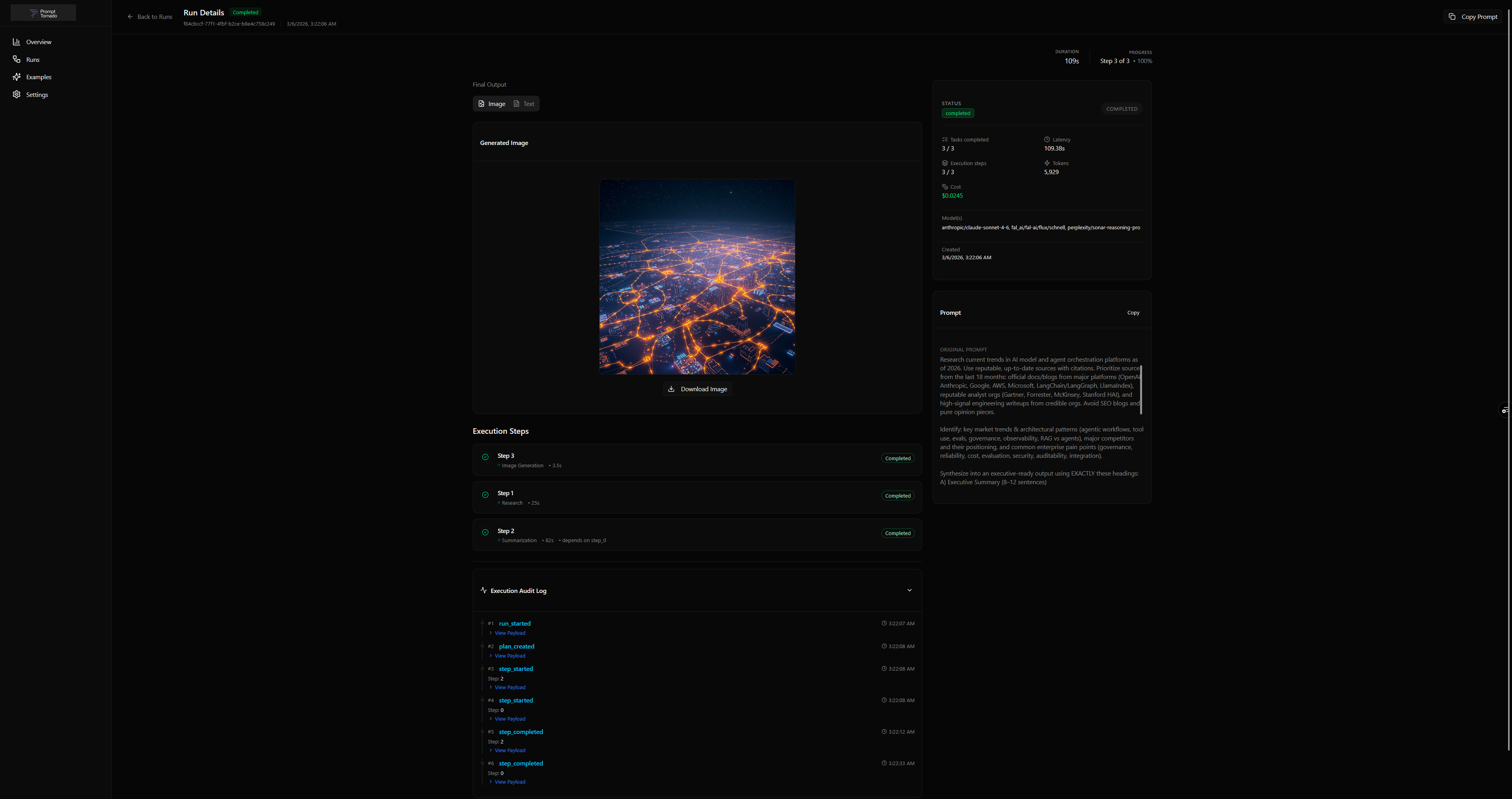
Prompt Tornado — Run Details with Execution Audit Log
f84cbccf · AI Market Research
3 steps · 3/3 completed 109s 5,929 tokens $0.0245 ✓ completed
Models routed in this run
anthropic/claude-sonnet-4-6 fal.ai/flux/schnell perplexity/sonar-reasoning-pro
Step execution trace — every decision logged
StepTask TypeModelDurationTokensStatus
Step 1Researchperplexity/sonar-reasoning-pro25s
✓ ok
Step 2Summarizationanthropic/claude-sonnet-4-682s5,929
✓ ok
Step 3Image Generationfal.ai/flux/schnell3.5s
✓ ok
Unified Output

3 typed outputs — research briefing, executive summary, generated image — returned as a single result. Every field is traceable to the step and model that produced it.

briefing.mdsummary.txtvisual.png
Evaluation Results

Built on real-world prompt evaluation.

Prompt Tornado's workflow planner was evaluated across 200 compound prompts representing real-world AI workflows — summarization, multilingual translation, research synthesis, code generation, image and audio creation, and multi-step task sequences.

Internal evaluation · 200 prompts · March 2026

200
Compound prompts evaluated
summarization · translation · research · code · image · audio
98%
Planning accuracy
valid schema · correct step ordering · no hallucinated tasks
4
AI providers routed automatically
Anthropic · fal.ai · ElevenLabs · Perplexity
100%
Deterministic planning
identical prompts produce identical workflow plans
Supported Models

Works with leading AI models

OpenAI
Anthropic
Gemini
Perplexity
Perplexity
Mistral AI
Mistral
fal.ai
fal.ai
11
ElevenLabs
ElevenLabs
Capabilities

What the control plane manages.

The pieces that turn a prompt into a production workflow — and keep it there.

🧩
Prompt Decomposition

A single compound prompt becomes a set of typed, discrete tasks. The decomposition is explicit and config-driven — not an opaque chain of inferences.

🔀
Per-Task Model Routing

Route each task to the model best suited for it. Routing rules live in your workflow definition — separate from application code, easy to change without a redeploy.

📦
Unified Output Structure

Every workflow returns a single typed result object — not a collection of raw completions. Every field maps back to the task and model that produced it.

📡
Execution Ledger

A full audit trail for every run: task-level tracing, model routing decisions, exact inputs and outputs, latency and token counts — all queryable after the fact.

🛡️
Fallback Routing

Define a fallback model per task. If the primary fails or is unavailable, the workflow continues — your application code doesn't need to handle the exception.

🔌
Config-Driven Workflows

Workflows are defined in config, not code. Add a model, change routing rules, or introduce a new task type without touching application logic.